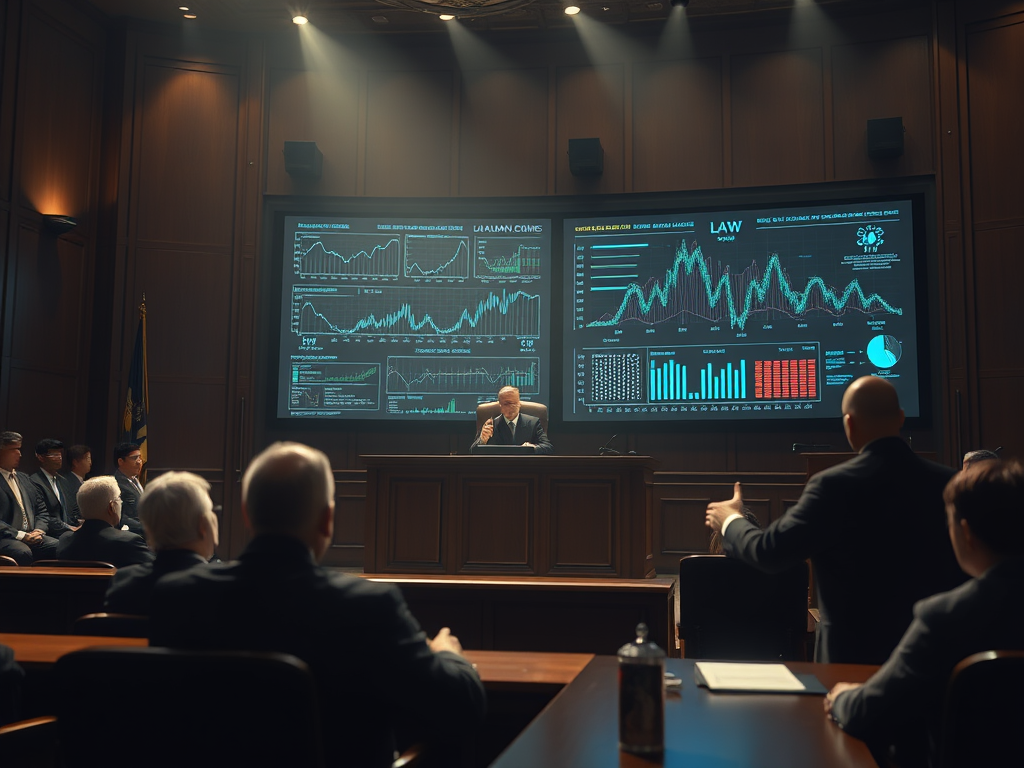
Every system examined in the previous four chapters — COMPAS at sentencing, the PSA at bail, Clearview AI at identification, predictive policing in patrol — eventually converges on the same procedural threshold. Before algorithmic output can influence what a jury decides, it must survive the courtroom. That moment is the procedural bottleneck of algorithmic criminal justice, and it is where evidentiary law, constitutional rights, and AI governance intersect.
This chapter examines the legal standards that govern that threshold, the structural conflict the trade secret problem creates, the evidentiary challenge that synthetic media poses, and the EU regulatory framework’s different approach to the same problem.
I. The existing framework: Rule 702 and the Daubert standard
Federal Rules of Evidence, Rule 702 Daubert v. Merrell Dow Pharmaceuticals, Inc., 509 U.S. 579 (1993) Kumho Tire Co. v. Carmichael, 526 U.S. 137 (1999)
The admissibility of scientific and technical evidence in federal courts is governed by Federal Rule of Evidence 702, which authorizes expert testimony when a witness with specialized knowledge will help the trier of fact understand the evidence or determine a fact in issue, and when the testimony is based on sufficient facts or data, employs reliable principles and methods, and reflects a reliable application of those methods to the facts of the case. Daubert v. Merrell Dow Pharmaceuticals, Inc., 509 U.S. 579 (1993), established that under Rule 702 the trial judge functions as a gatekeeper, responsible for determining before trial whether proffered scientific or technical evidence is sufficiently reliable to be presented to the jury. Kumho Tire Co. v. Carmichael, 526 U.S. 137 (1999), extended that gatekeeping function beyond formal scientific opinion to all expert testimony, including technical and experiential evidence.
Courts evaluating algorithmic outputs under the Daubert framework examine several factors: whether the methodology has been empirically tested and can produce falsifiable results; whether it has been subjected to peer review and publication in the relevant scientific community; what the known or potential error rate is; and whether the methodology is generally accepted within the relevant expert community. Each of those factors creates a specific litigation target for the defense lawyer confronting algorithmic evidence.
Testability matters because many machine-learning systems are trained on limited or jurisdiction-specific datasets and may perform materially differently in deployment than in controlled testing. Peer review matters because many proprietary forensic and criminal justice algorithms have never been subjected to independent scientific evaluation — the Clearview AI database examined in Chapter 27 and the COMPAS methodology examined in Chapter 25 are both examples. Error rate matters because a system’s false positive rate in one-to-many search scenarios, or its recidivism prediction accuracy, may diverge sharply from the accuracy claims in vendor marketing materials, as NISTIR 8280 documented for facial recognition and as the Dressel and Farid study documented for COMPAS. General acceptance matters because several algorithmic criminal justice tools — including ShotSpotter — have faced active scientific dispute over their operational validity, undermining the claim that the methodology is settled.
States that apply the older Frye standard, derived from Frye v. United States, 293 F. 1013 (D.C. Cir. 1923), use a somewhat different test — whether the methodology is generally accepted within the relevant scientific community — but the practical result for algorithmic evidence is similar: the proponent must demonstrate scientific legitimacy, not merely vendor-certified accuracy.
II. Proposed Federal Rule of Evidence 707 — machine-generated evidence
Proposed Federal Rule of Evidence 707, published for public comment August 2025 Public comment period closed February 16, 2026
The existing Rule 702 framework was designed for human expert witnesses who can be deposed, cross-examined, and required to explain their reasoning. It does not directly address the situation in which machine-generated output is offered as evidence without any accompanying human expert — a scenario that, as the preceding chapters have documented, is increasingly common in criminal proceedings.
On May 2, 2025, the Advisory Committee on Evidence Rules proposed a new Federal Rule of Evidence 707 specifically addressing this gap. The Standing Committee on Rules of Practice and Procedure approved the proposal for publication on June 10, 2025. The rule was published for public comment on August 16, 2025. The public comment period closed on February 16, 2026 — weeks before this chapter was written — and the Advisory Committee is scheduled to review the comments and produce a final report in June 2026. If approved through the required Judicial Conference and Supreme Court review process, the rule is projected to take effect on December 1, 2026.
The text of Proposed Rule 707 provides: “When machine-generated evidence is offered without an expert witness and would be subject to Rule 702 if testified to by a witness, the court may admit the evidence only if it satisfies the requirements of Rule 702(a)-(d). This rule does not apply to the output of simple scientific instruments.”
The legal significance of that text is precise. Where a party offers AI-generated output — a risk score, a facial-recognition match result, an acoustic detection alert — without calling a human expert to explain and defend the methodology, the proponent must nevertheless satisfy the Rule 702 standards: sufficient facts or data, reliable principles and methods, and reliable application of those methods to the facts of the case. The machine cannot testify. But the proponent cannot avoid the reliability obligation by choosing not to call one. Louisiana became the first state to enact a comparable framework on August 1, 2025. Public comments on the federal proposal raised several substantive objections: that “machine-generated evidence” is not defined in the rule text; that the procedure for satisfying Rule 702 standards is unclear when no qualified expert is available to examine; and that the rule addresses only evidence the proponent acknowledges to be AI-generated, leaving unauthenticated deepfakes and other synthetic media beyond its scope.
For defense lawyers, the significance of Proposed Rule 707 is immediate and practical. Even before formal adoption, the proposal documents a judicial consensus that algorithmic evidence cannot bypass reliability standards by entering the courtroom without expert accountability. Defense counsel can use that emerging consensus — and the Advisory Committee’s own reasoning — to support Daubert challenges to algorithmic outputs admitted without adequate expert foundation, regardless of whether Rule 707 itself is yet in force.
III. The trade secret problem — when reliability cannot be tested
U.S. Constitution, Amendment VI — Confrontation Clause U.S. Constitution, Amendment V — Due Process Clause Ake v. Oklahoma, 470 U.S. 68 (1985)
The reliability framework established by Rule 702 and Daubert presupposes that the evidence can be examined. In algorithmic criminal justice, that presupposition frequently fails.
Vendors of forensic and risk-assessment algorithms routinely claim that their source code, model architecture, training data, and weighting methodology constitute proprietary trade secrets whose disclosure would cause competitive harm. When law enforcement relies on those systems, the defense encounters a structural obstacle: the evidence is offered as reliable, but the methodology that would allow the defense to test that reliability is withheld. As Chapter 25 documented in the context of State v. Loomis, 881 N.W.2d 749 (Wis. 2016), the Wisconsin Supreme Court accepted that obstacle at sentencing; the Loomis court held that disclosure of the COMPAS methodology was not constitutionally required, provided that the score was used as one factor among many and that the defendant had access to the underlying inputs. That holding remains the most influential precedent on the question, and it is a troubling one.
The Sixth Amendment Confrontation Clause guarantees the accused the right to confront the witnesses against them. Algorithmic systems are not witnesses in the doctrinal sense, but the confrontation principle extends beyond the literal right to cross-examine human witnesses: it encompasses the right to test the reliability of the evidence the state uses against the defendant. Where that evidence is generated by a proprietary system whose internal logic cannot be examined, the confrontation principle is undermined in practice even if no formal doctrinal violation is found.
The Fifth Amendment due process argument is more direct. Ake v. Oklahoma, 470 U.S. 68 (1985), established that where the state’s case rests on evidence requiring expert interpretation, the defendant has a due process right to access the expert assistance necessary to challenge that evidence. Applied to algorithmic evidence, the Ake principle supports an argument that where the prosecution relies on a risk score or forensic output generated by a proprietary system, and where that system’s methodology is shielded from defense examination, the defendant is denied the expert access necessary for meaningful challenge.
Courts have responded to this tension with increasing willingness to impose limited disclosure under protective orders — arrangements that permit defense-retained experts to examine the algorithm’s architecture and training data under confidentiality restrictions, without requiring public disclosure. Where the vendor refuses even limited disclosure under protective order, some courts have excluded the evidence rather than permit the prosecution to benefit from a system the defense cannot test. That developing judicial trend — exclusion as the remedy for irreducible opacity — is the most powerful leverage point available to defense counsel in trade-secret algorithmic cases.
IV. Deepfakes and the authentication problem
Federal Rules of Evidence, Rule 901 Federal Rules of Evidence, Rule 403
For decades, video and audio recordings carried strong presumptive credibility in criminal proceedings. Courts generally assumed that recordings accurately depicted the events they captured. Generative AI has disrupted that assumption in both directions simultaneously: it has made fabricated audiovisual evidence easier to produce and, through the phenomenon described in the scholarship as the “liar’s dividend,” it has made authentic recordings easier to challenge by raising the mere possibility that the evidence might be synthetic.
Authentication under Federal Rule of Evidence 901 requires that the proponent demonstrate the item is what it claims to be. Traditionally, that was accomplished through witness testimony, chain-of-custody documentation, or circumstantial indicia of authenticity. As synthetic media has become more sophisticated, courts and practitioners have moved toward supplementary verification: metadata analysis to establish provenance, cryptographic hash verification to establish that a file has not been altered, forensic video analysis to identify compression artifacts or generative inconsistencies, and secure chain-of-custody records from the point of capture through presentation.
The Advisory Committee on Evidence Rules considered a parallel amendment to Rule 901 that would have established a specialized authentication procedure for potential deepfakes, but tabled that proposal as of the spring 2025 meeting, concluding that synthetic media constitutes a sophisticated form of forgery that existing Rule 901 flexibility can accommodate. The consequence is that deepfake challenges in criminal proceedings will be litigated under the general authentication framework rather than a specialized rule — at least until the Advisory Committee revisits the question.
Federal Rule of Evidence 403 provides a separate tool: even if AI-enhanced or AI-generated evidence is technically authenticated, a court may exclude it if its probative value is substantially outweighed by the danger of unfair prejudice, confusion of the issues, or misleading the jury. Where the defense can establish that AI-processed surveillance footage has been enhanced in ways that may introduce artifacts rather than revealing facts — a concern documented in studies of AI video enhancement — the Rule 403 balancing argument is available.
V. The EU framework: transparency as a structural requirement
EU AI Act, Regulation (EU) 2024/1689, Articles 13, 14, and 19 GDPR, Regulation (EU) 2016/679, Articles 5 and 22
As established in Chapter 24, the European regulatory approach to AI in criminal justice is structural rather than reactive. Rather than addressing reliability after a wrongful outcome, the EU AI Act builds transparency and accountability requirements into the deployment of AI systems before they produce evidence.
Under Regulation (EU) 2024/1689, Article 13, high-risk AI systems must be designed so that their outputs can be interpreted by human operators, and deployers must receive sufficient information about system limitations and methodology to evaluate outputs correctly. Article 19 requires that providers of high-risk systems in law enforcement contexts register those systems in the EU database established under Article 71 — a public disclosure requirement that is structurally incompatible with the trade-secret opacity that Loomis tolerated. Article 14 requires that high-risk systems be subject to effective human oversight by persons with sufficient understanding of the system’s capabilities and limitations to detect and address failures. An oversight mechanism that cannot identify a false positive because the methodology is withheld does not satisfy Article 14.
The transparency obligations of the EU AI Act do not guarantee that European courts will have access to algorithmic source code in criminal proceedings — that question is governed by member state criminal procedure law. But they do guarantee that the deployer has documentation of the system’s methodology, validation, and limitations, and that documentation is available to regulators and, through litigation, to defense counsel. The information asymmetry that defines the US trade-secret problem is structurally narrower in the EU framework.
VI. Practical tools for criminal defense lawyers
Daubert v. Merrell Dow Pharmaceuticals, Inc., 509 U.S. 579 (1993) Brady v. Maryland, 373 U.S. 83 (1963)
The defense lawyer confronting algorithmic evidence has several procedural tools available. The Brady v. Maryland, 373 U.S. 83 (1963), obligation to disclose exculpatory evidence extends to evidence bearing on the reliability of the state’s expert methods — including validation studies, internal audit results, and documented error rates of the algorithmic system used. Brady requests should specifically identify the system by name, the specific evidence type it generated, and the categories of documentation that bear on its reliability.
Discovery beyond Brady should include the vendor’s most recent validation study for the specific jurisdiction where the system was deployed, any internal audit or error analysis generated by the agency using the system, the version of the system used at the time the evidence was generated, and any documentation of the human review process applied to the algorithmic output before action was taken. Where the system’s methodology is claimed as a trade secret, the motion to compel should argue both the due process principles from Ake and the exclusion remedy developed in recent trial court decisions — making clear that the prosecution cannot simultaneously rely on a proprietary tool and deny the defense the access necessary to test its reliability.
Expert assistance is often essential. The Advisory Committee on Evidence Rules’ own reasoning in developing Proposed Rule 707 underscores that algorithmic evidence involves methodological complexity that requires expert interpretation — the same reasoning that supports the Ake due process argument for defense expert access. A defense expert who can analyze the system’s claimed error rate, training data representativeness, and the conditions of the specific search against the Daubert reliability factors gives the court a concrete basis for exclusion rather than an abstract constitutional argument.
Next: Chapter 30 — Mass surveillance: FISA, the Patriot Act, and the AI Act.
Leave a Reply