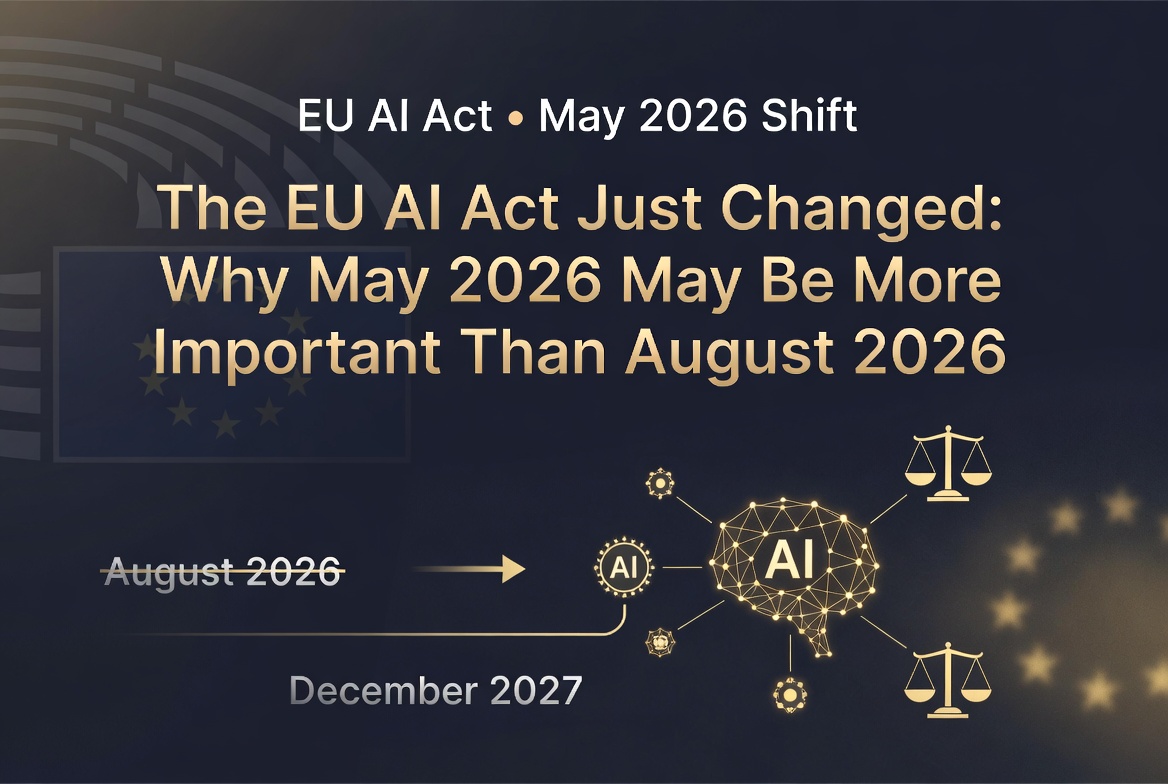
For nearly two years, companies across Europe and beyond treated 2 August 2026 as the make or break deadline for the EU AI Act’s high-risk obligations. That assumption is no longer stable.
In the early hours of 7 May 2026, after a failed trilogue on 28 April, European Parliament and Council negotiators reached a provisional political agreement on the Digital Omnibus on AI, the AI-specific track of the Commission’s seventh Omnibus package (COM(2025) 836, published 19 November 2025). The deal adjusts implementation timelines, introduces targeted simplifications, and adds new prohibitions.
Most headlines called it a “delay.” That framing is incomplete, and for anyone running AI systems, strategically dangerous.
What happened in May 2026 is not a retreat from AI regulation. It is the start of a more politically realistic phase of EU AI governance: one that prioritizes operational enforceability, industrial competitiveness, and practical implementation over symbolic speed. For organizations deploying AI, the implications are significant.
What Actually Changed
The provisional agreement pushes back the application of high-risk obligations under the EU AI Act (Regulation (EU) 2024/1689) and fixes them to firm calendar dates rather than standards-dependent triggers:
- Stand-alone high-risk AI systems (Annex III categories: employment, credit scoring, biometrics, education, critical infrastructure, law enforcement) now apply from 2 December 2027.
- High-risk AI embedded in regulated products (Annex I sectors: medical devices, machinery, toys) now apply from 2 August 2028.
This is a structural shift from the original design, where Annex III high-risk obligations were set for 2 August 2026 and Annex I for 2 August 2027.
Additional measures in the agreement include:
- New Article 5 prohibition targeting AI systems that generate non-consensual intimate imagery (NCIM), including so-called “nudifier” apps, or child sexual abuse material (CSAM). Per the Parliament’s communication, the ban applies from 2 December 2026, reaching systems where such generation is the intended purpose or is reasonably foreseeable and the system lacks safeguards to prevent it.
- Article 50(2) transparency / watermarking for AI-generated content moved to 2 December 2026, postponing the original 2 August 2026 date by four months, with a compressed grace period. The Commission opened its consultation on the draft Article 50 transparency guidelines on 8 May 2026, running until 3 June 2026.
- Reduced overlap with sectoral legislation: a carve-out for AI-enabled machinery, narrowing of the “safety component” concept, and Commission guidance aimed at minimizing double compliance.
- Postponement of national AI regulatory sandboxes to 2 August 2027.
- Reinstated elements: a simplified registration obligation for certain non-high-risk and borderline systems in the EU database, and the “strict necessity” standard for processing special categories of personal data in bias detection and mitigation.
- SME and small mid-cap relief and measures to reduce administrative burden.
Crucially, the core architecture of the AI Act remains intact. Prohibited practices (in force since February 2025), GPAI model obligations (since August 2025), AI literacy requirements (Article 4), and general governance and transparency expectations all continue. The regulation has not been repealed, suspended, or fundamentally weakened.
The EU is not abandoning AI regulation. It is buying time to make enforcement workable.
Status: Politically Agreed, Not Yet Law
This is a provisional political agreement, not final law. The European Parliament and Council must still formally adopt the text. Formal adoption is expected around June 2026, with publication in the Official Journal and entry into force three days later, deliberately timed to land just before the original 2 August 2026 deadline. The consolidated legal text may contain refinements not visible in the current Parliament communication. Organizations should track the Official Journal and AI Office guidance for the final wording.
Why the EU Made These Changes
The official rationale is straightforward: the ecosystem was not ready. The bloc still lacks sufficient harmonized technical standards, detailed guidance, notified bodies, and operational tooling for scaled enforcement of high-risk rules.
Three deeper realities drove the shift:
- Operational unreadiness. Many organizations still lack reliable AI inventories, clear classification processes, defined provider and deployer roles, data flow mapping, and human oversight mechanisms.
- Standards and guidance lag. Without concrete technical pathways, legal obligations risk producing fragmentation, inconsistency, and litigation rather than compliance.
- Competitiveness pressure. Between 2024 and 2026 the political climate shifted. The EU is now explicitly balancing safety and trust against the risk of making Europe uncompetitive for AI innovation. The Omnibus reflects that industrial reality.
The Dangerous Misinterpretation
Many organizations are reacting with relief: “Good, more time, we can wait.” That is strategically reckless.
Even with high-risk delays, critical elements remain active or advance on or near their original schedule:
- Prohibited AI practices
- GPAI model obligations
- Transparency and disclosure rules, with the December 2026 watermarking milestone now firmly dated
- AI literacy obligations under Article 4
- Internal accountability and governance expectations
- Procurement scrutiny, investor due diligence, vendor reviews, and cross-border contract requirements
The delay does not reduce the compliance workload. It redistributes it toward whoever procrastinates. Organizations that build governance maturity now will be operationally ready by late 2027. Those that wait will still be trying to identify their AI systems when enforcement arrives.
The Real Problem Was Never Just Documentation
Compliance is not primarily about producing policies and PDFs. The hardest part is governance visibility: knowing what AI you have, how it is used, who owns it, what data it touches, and how risks are managed across fragmented systems and shadow AI.
The May 2026 changes indirectly confirm this gap. Brussels effectively acknowledged that even sophisticated organizations lack the operational maturity for immediate large-scale enforcement.
Why This Matters Beyond Europe
US and global companies often treat the AI Act as “a European problem.” That view is becoming unrealistic.
The Act applies extraterritorially in many cases involving the EU market. More importantly, it is becoming the de facto global operational governance benchmark for enterprise AI, much as GDPR did before it. AI Act-style requirements are already appearing in procurement questionnaires, vendor due diligence, investor risk reviews, cybersecurity assessments, and cross-border contracts worldwide.
The Real Strategic Shift
The story of May 2026 is not the delay. It is the transition from regulation drafting to regulation operationalization.
The conversation is moving from “What does the law say?” to “How do organizations actually implement this at scale?”
Operational AI governance is harder than legal interpretation. It demands:
- Comprehensive AI inventories and classification
- Traceability and lifecycle controls
- Evidence management and auditability
- Human oversight workflows
- Clear governance architecture across engineering, legal, compliance, and business teams
Organizations building these capabilities now will lead the next phase. The rest will spend 2027 and 2028 playing catch-up.
Final Reality Check
The May 2026 AI Omnibus agreement should not be read as deregulation. It should be read as a warning.
The EU looked at the market and concluded that even advanced organizations remain operationally unprepared for serious AI governance at scale. So Brussels slowed enforcement. It did not slow the direction of travel.
The era of informal, undocumented, ungoverned enterprise AI deployment is ending. The only real question is which organizations understand this before enforcement becomes real.
The Guilty Algorithm will keep tracking how these rules move from paper to practice, and which organizations are actually ready when the clock runs out.
Working Through the EU AI Act From the US Side?
The new timelines do not reduce the work. They expose how much groundwork most organizations still have not done: knowing which systems are in scope, who owns them, what data they touch, and how to evidence oversight before enforcement arrives.
Lexara Advisory is a New York based AI governance consultancy that helps US and international companies operationalize the EU AI Act and connected frameworks. It is led by a European-barred lawyer (admitted to the Spanish Bar, ICATF nº 5961, since 2016), combining direct European regulatory grounding with the practical realities of how American organizations actually run.
Lexara focuses on the operational side this article is about:
- EU AI Act scope assessment and high-risk classification
- Gap analysis and tailored compliance roadmaps mapped to the new December 2027 and August 2028 timelines
- AI risk assessments covering bias, fairness, and data protection
- Cross-border strategy integrating the EU AI Act with GDPR and NYC Local Law 144
Lexara Advisory is a governance and compliance consultancy. It delivers actionable documentation, assessments, and ongoing advisory support.
Start here: lexaraadvisory.com
Leave a Reply